Perched nearly 4,000 metres above Chamonix, the Aiguille du Midi blends geology, engineering, and breathtaking alpine scenery. On a July morning I ascended by cable car, stepped into tunnels carved from granite, and stood among Mont Blanc’s peaks – discovering the forces and human ingenuity that shaped this extraordinary station.
1 Chamonix: Gateway to the Aiguille du Midi
I have always thought of Chamonix as a town that breathes mountain air in its sleep. It sits at the foot of Mont Blanc like a climber poised before a summit push, surrounded by ridges that cut the sky into ragged patterns. This past July, I returned to this Alpine capital for the second time, but unlike my first visit, when the Aiguille du Midi cable car was closed due to the COVID-19 pandemic, this time the mountain had flung its gates wide open.
It was my golden opportunity to stand on that dizzying perch at 3,842 metres, to peer across the Alps, and to walk inside a mountain carved from ancient granite – a place where the forces of geology and engineering meet in perfect harmony.
2 Quick Facts About Aiguille du Midi
- Location: Chamonix, Haute-Savoie, France
- Altitude: 3,842 m (12,605 ft)
- Mountain Range: Mont Blanc Massif, French Alps
- Geology: Primarily granite, formed from slowly cooled magma deep underground during the Alpine orogeny (~40 million years ago)
- Cable Car Inauguration: 1955 (then the highest in the world)
- Journey Time: ~20 minutes from Chamonix, with one mid-station stop at Plan de l’Aiguille (2,317 m)
- Ticket Prices: Adult round-trip ticket from approximately €59.90 to €81; mid-station round-trip about €41.20
- Opening Period: Generally open year-round, with an annual maintenance closure in November (usually lasting two to three weeks)
- Operating Hours: First ascent around 6:10 am; last return between 17:30 and 18:00, depending on traffic and season
- Temperature Difference: Often 20 – 25°C cooler at the summit than in Chamonix
- Views: Mont Blanc, Dent du Géant, Vallée Blanche, peaks of Italy and Switzerland
- Activities: Observation decks, skywalk, mountaineer access to the Vallée Blanche, learning center, photography
3 An Early Morning in Chamonix
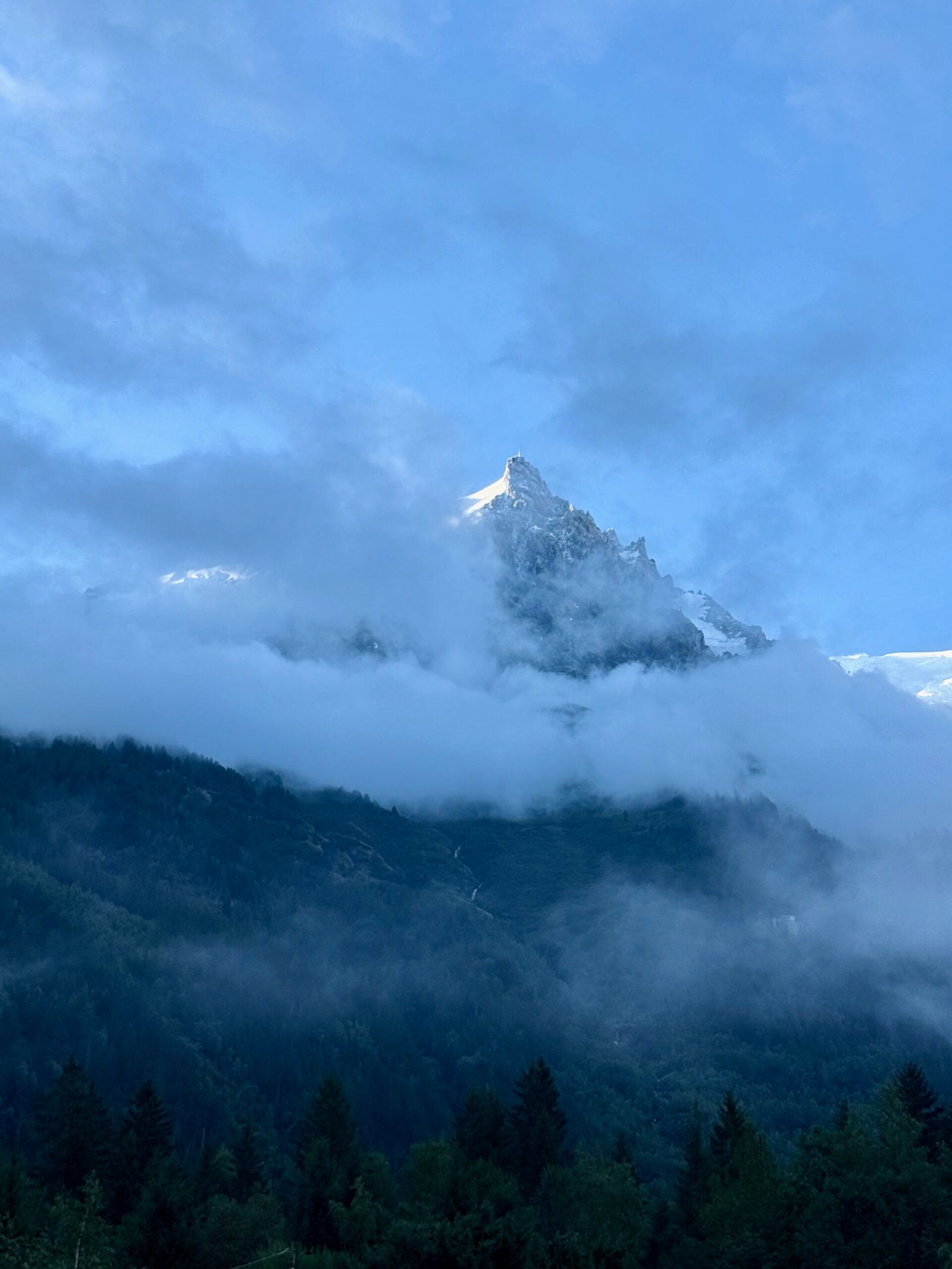
The streets of Chamonix were still stretching awake when I set out from my hotel. As I walked, I kept glancing upward toward the Aiguille du Midi, which revealed itself through a break in the morning clouds, peering down at me with what felt like a huge smile, as if it had been waiting for my arrival. I had booked my ascent for one of the earliest possible slots at 7:20 am – partly for the clearer skies, partly for the chance to experience the summit before the crowds swelled. Even at this hour, the base station was buzzing. There was a sense of collective anticipation, as if we were all about to embark on a shared expedition.
I clutched my Mont Blanc Multipass – a two-day ticket that would also carry me to the Mer de Glace and its surreal ice cave, the Grotte de Glace, and up the cogwheel train toward Mont Blanc. But this morning was all about the Aiguille.
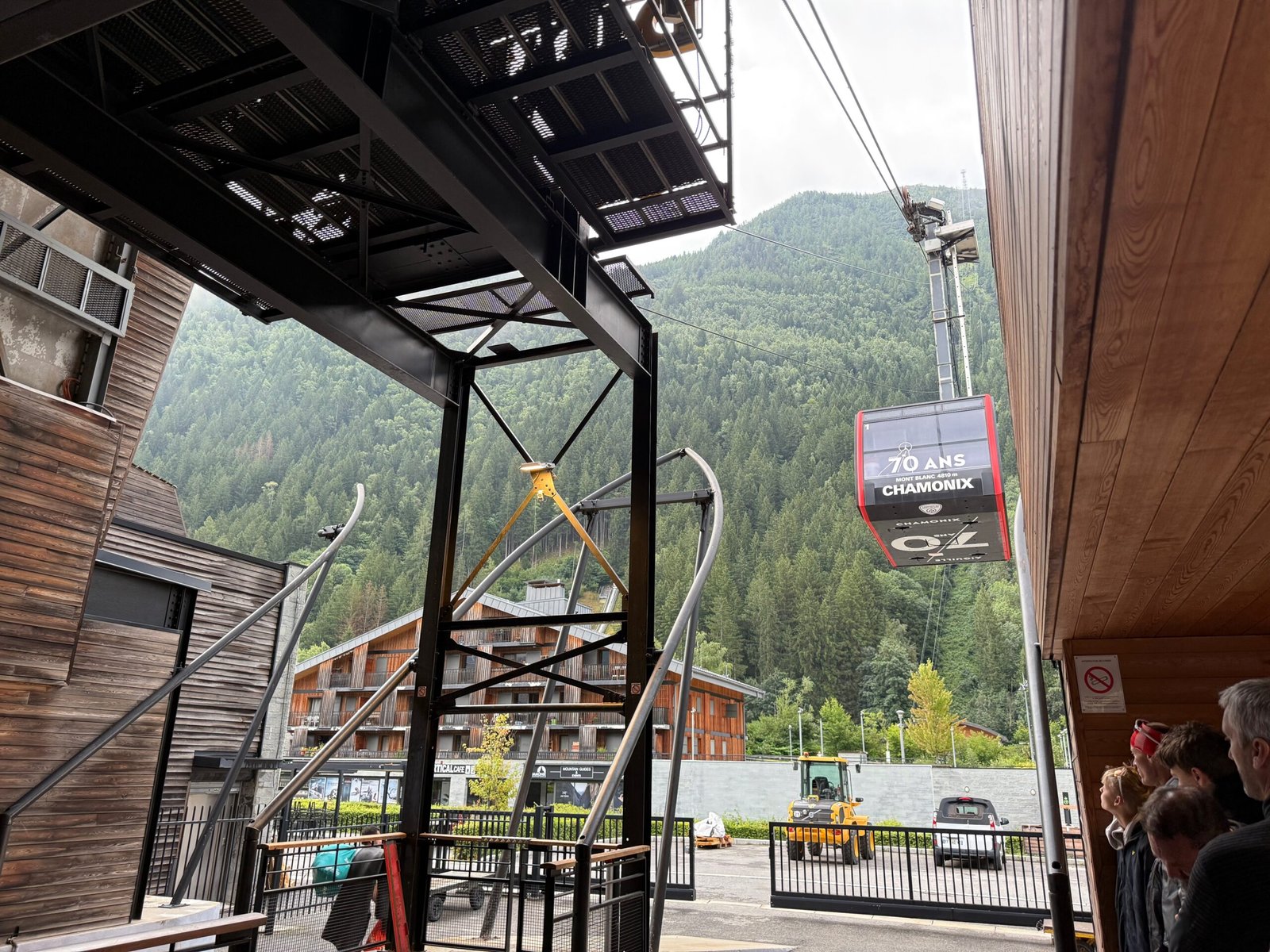
When my assigned cable car appeared, a sleek red-and-white capsule sliding down its impossibly thin cable, conversations quieted. We shuffled aboard, pressing against the glass, and the doors closed with a hiss. Then, with barely a jolt, we began to rise.
4 The Aiguille du Midi Cable Car Ascent
The climb from Chamonix to the Aiguille du Midi takes about 20 minutes, split into two stages. The first leg sweeps over pine forests and summer meadows, past clusters of chalets that seem almost painted into the green slopes. As we gained altitude, the trees thinned, replaced by raw rock and lingering patches of snow.
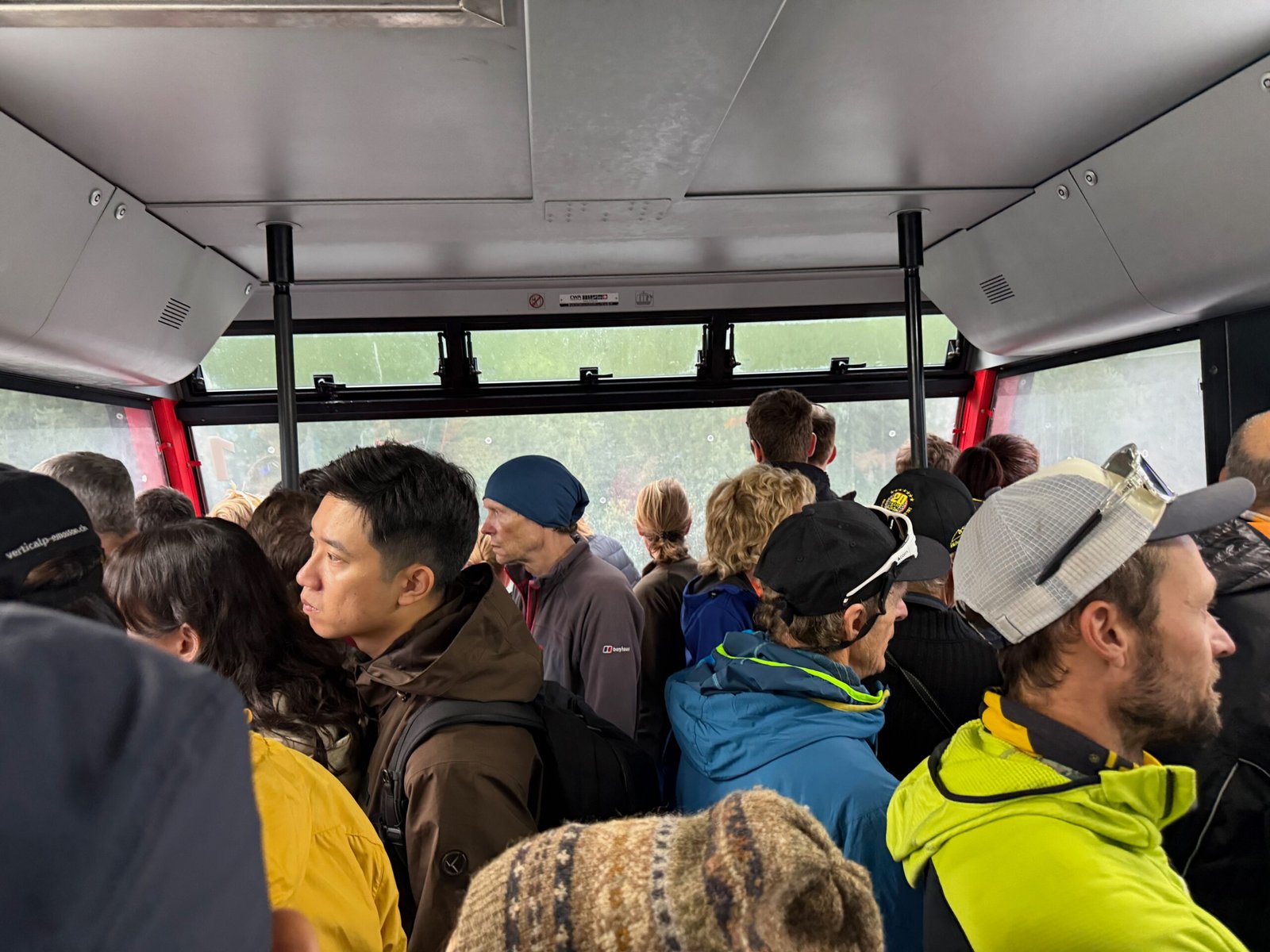
About halfway up, we glided into the mid-station at Plan de l’Aiguille (2,317 m). Here, we stepped out and boarded the second cable car – a sleeker, more compact cabin that would carry us the rest of the way to the summit. This second leg rose steeply above cliffs and glaciers, each passing metre peeling back a little more of the high Alpine world.
Soon, clouds enveloped us, soft white nothingness outside the window. I could feel the collective breath-hold in the cabin, everyone waiting for the reveal. And then, just as suddenly, the cloud thinned and parted.
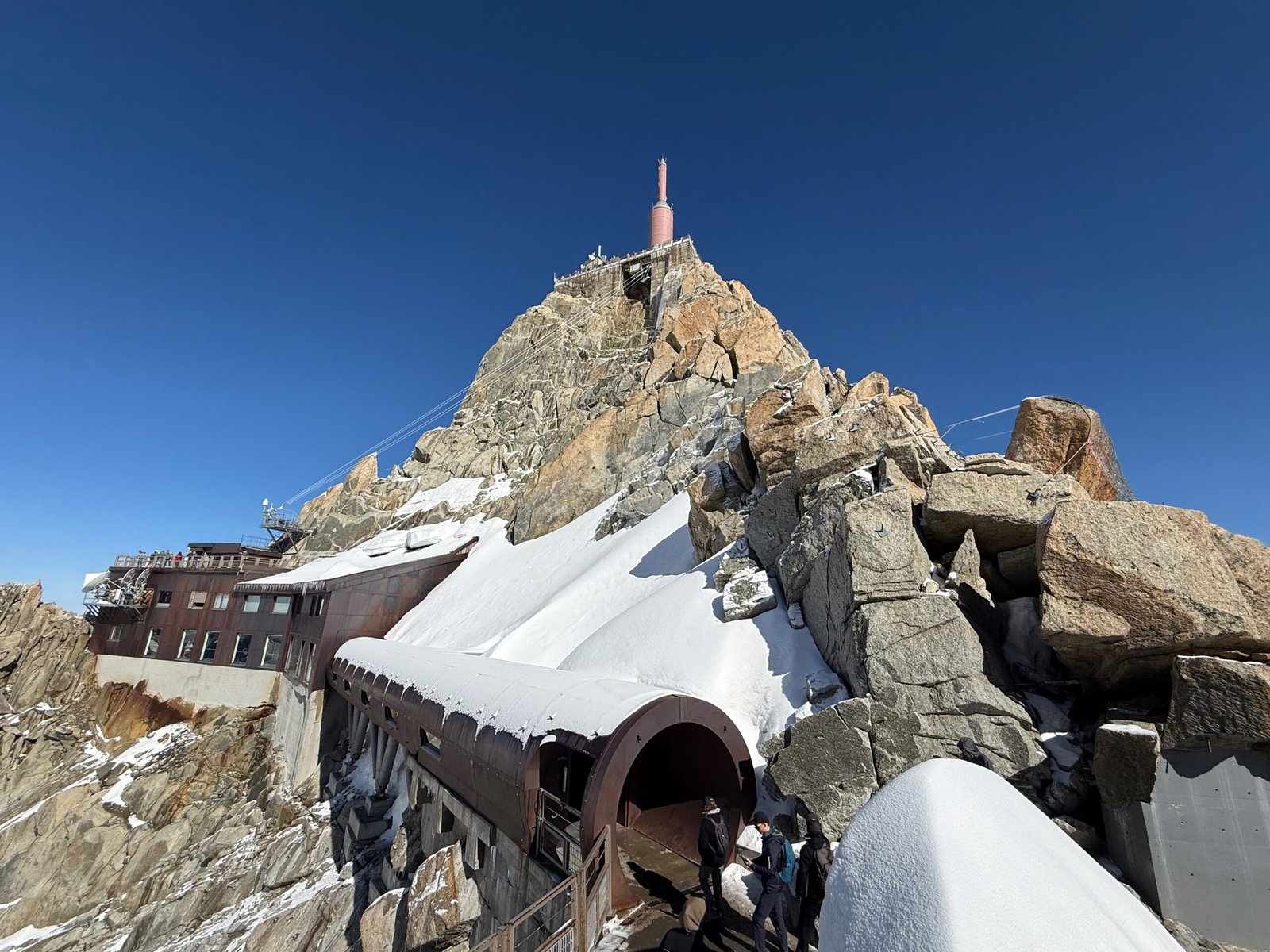
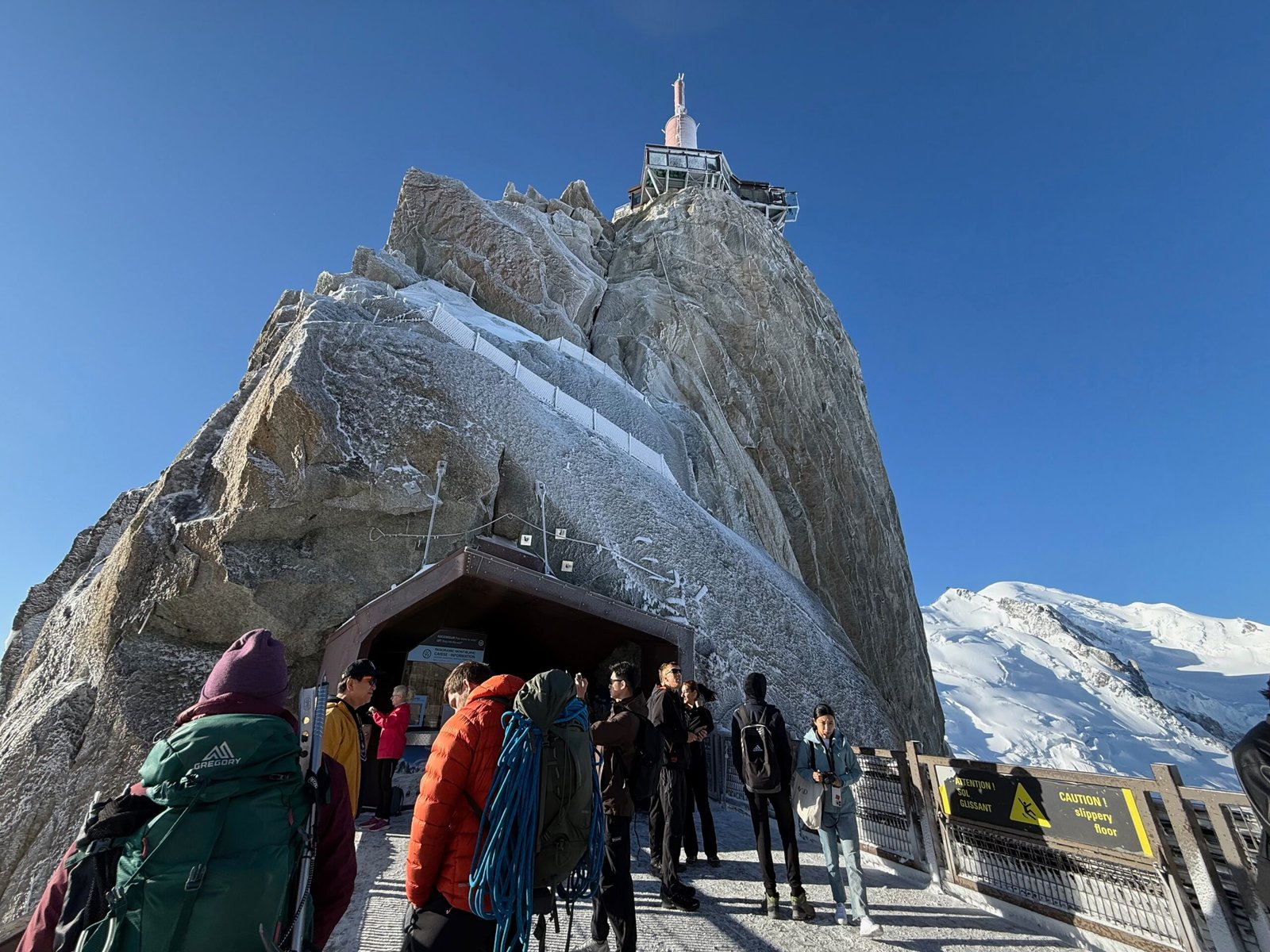
The Aiguille du Midi appeared – a sharp spire of rock crowned by a needle-like antenna, clinging to the cliff like a lunar outpost. The scale was staggering. It didn’t just sit on the mountain, it was part of it.
5 First Steps on the Summit
Stepping out of the cable car was like walking into another world. The air was sharp, thinner, and cooler at about –2°C despite the summer sun. In Chamonix that morning it had been 16°C; up here, winter lingered year-round. I felt my breathing quicken, each inhale pulling in less oxygen than my body expected. This is the reality at nearly 4,000 metres – oxygen levels are about 40% lower than at sea level.
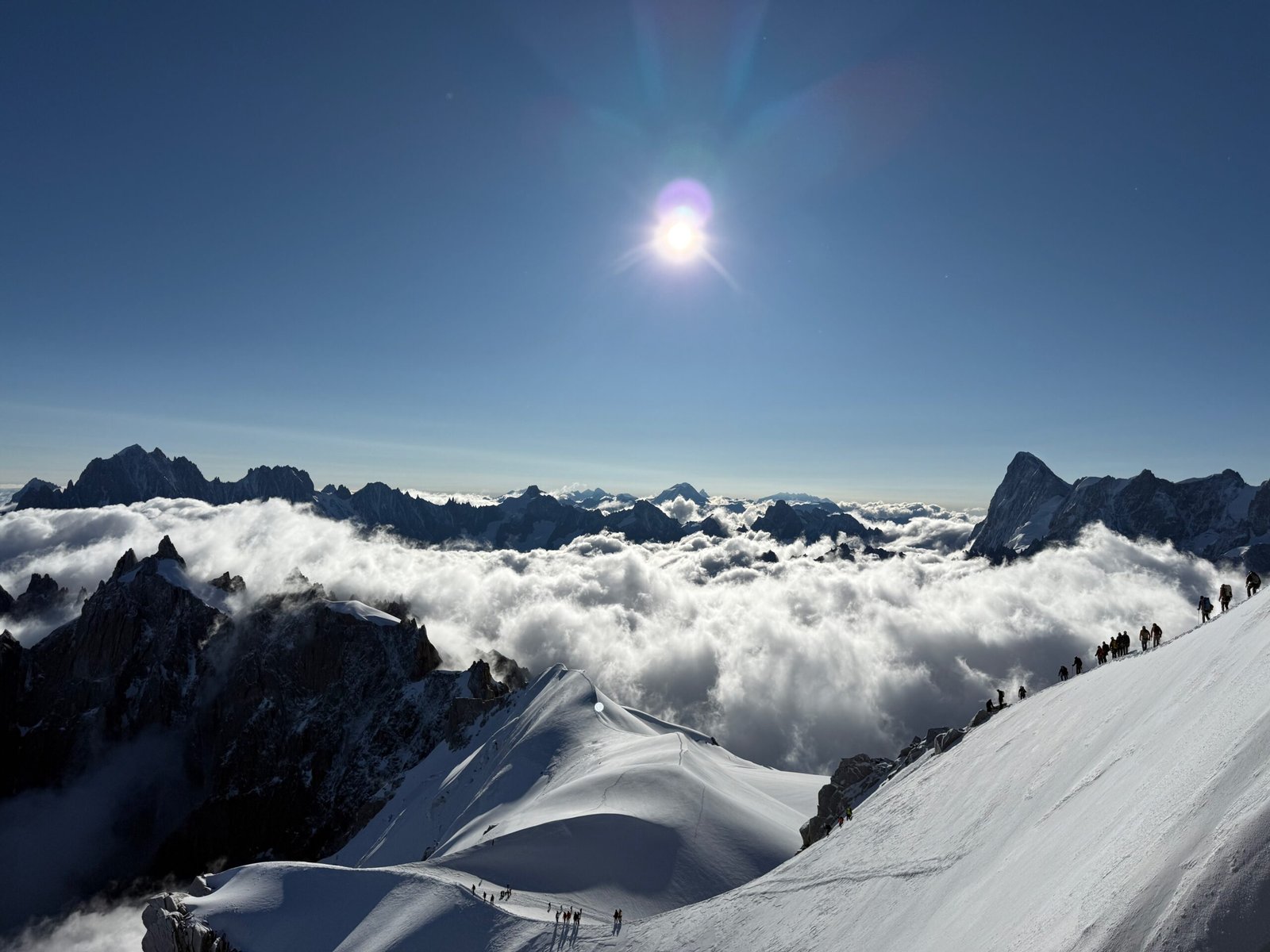
For a moment, I just stood still, letting my eyes soak in the panorama. Mont Blanc loomed so close it felt within reach. To the southeast, the jagged Dent du Géant. To the south, Italy’s Aosta Valley. To the east, the peaks faded into a blue haze toward Switzerland.
6 Inside the Mountain: Granite, Tunnels, and Deep Time
The station itself is carved into the granite of the Aiguille. Walking its tunnels is like stepping into Earth’s deep history. Granite is an igneous rock formed when molten magma cools slowly underground – so slowly that crystals of quartz, feldspar, and mica grow large enough to see with the naked eye.
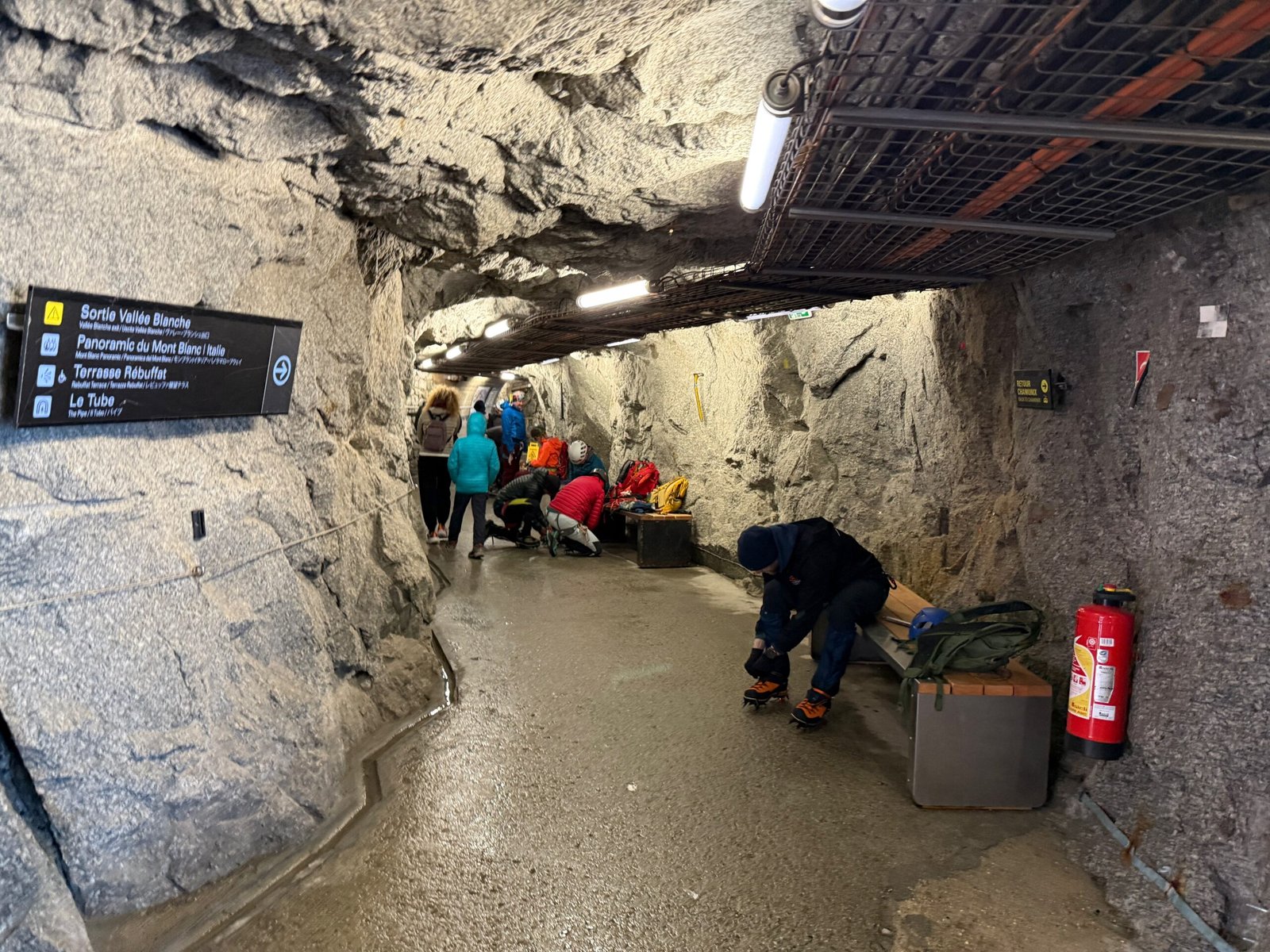
This granite began its existence tens of kilometres beneath the surface. Around 40 million years ago, the African Plate began colliding with the Eurasian Plate, pushing up the Alps in a slow-motion tectonic crash that continues today. Over millions of years, erosion stripped away the overlying rock, revealing this granite core.
The climate at the summit is as formidable as the geology. Even in summer, temperatures often hover near freezing and can drop well below –20°C in winter. The Aiguille du Midi is exposed to fierce winds that can exceed 100 km/h (62 mph) during storms, and receives heavy annual snowfall – often several metres, that can persist on shaded ledges year-round. This harsh environment demands constant maintenance and engineering adaptations to keep the station operational.
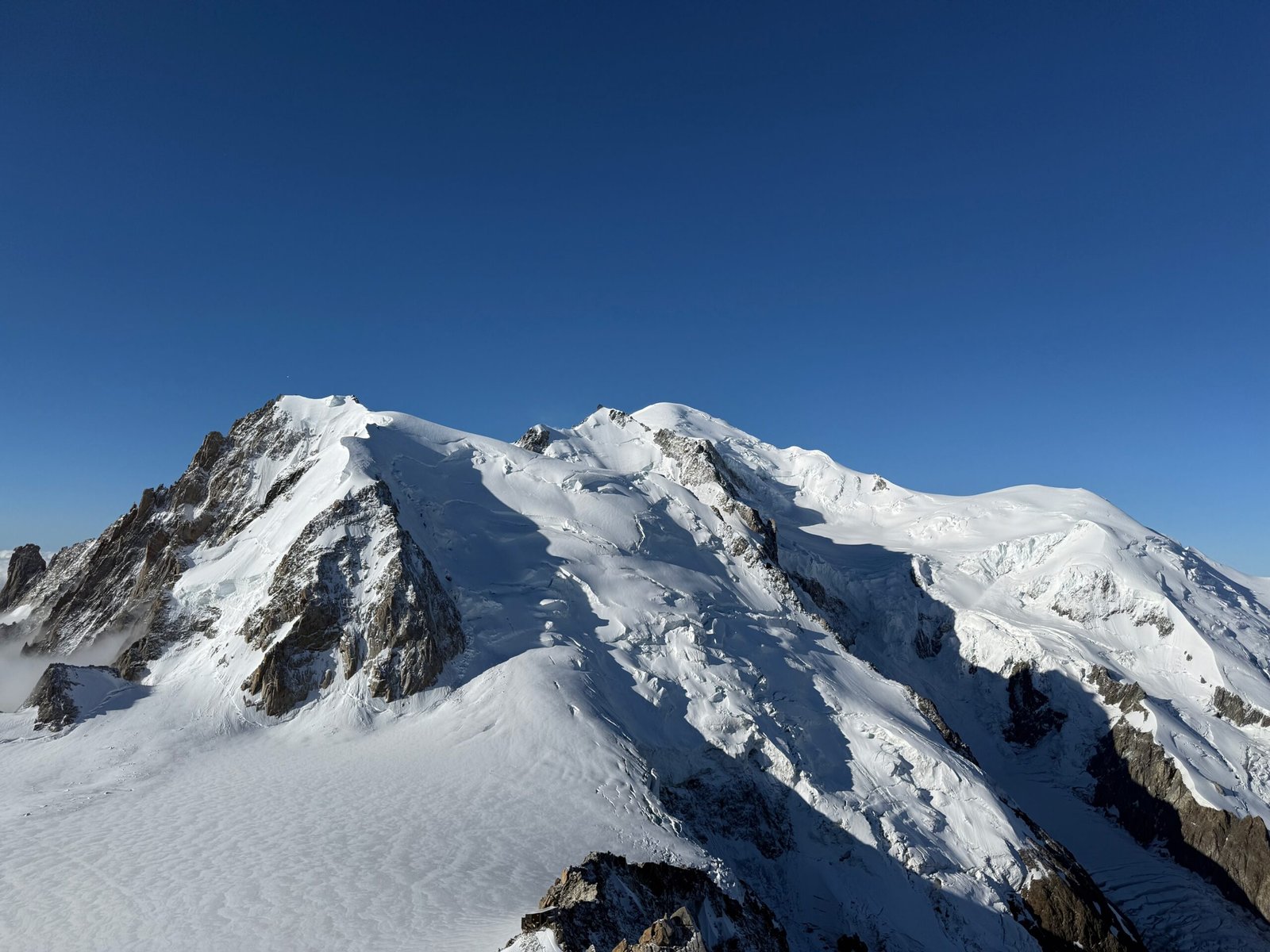
Touching the cold, speckled walls of the tunnels, I thought of how impossibly old they are, and how the very forces that brought them here are still shaping the mountains. The collision between Africa and Eurasia hasn’t stopped; the Mont Blanc Massif, including the Aiguille du Midi, is still rising by roughly 1–2 millimeters per year, a barely perceptible lift that adds up over geological time. Even as glaciers and frost steadily wear them down, these peaks continue their slow ascent toward the sky.
7 The History of the Station
The dream of ascending the Aiguille du Midi via cable car first surfaced in the early 1900s. Initial plans by Swiss engineers Wilhelm Feldmann and Emil Strub envisioned a series of aerial funiculars stretching from Chamonix to the summit – a bold concept for the era. 
Early Ambition and Construction (1909 – 1927)
A concession was granted in 1909 to build a valley-to-mountain cable system. Construction began swiftly, with railway stations established at Pélerins and La Para by 1913. Materials, such as stone for masonry and wood for infrastructure, were sourced directly from the mountain itself, minimizing transport. 
World War I halted progress, but the first section, from Pélerins to La Para, finally opened in 1924, becoming France’s first cable car. The second leg, connecting to Les Glaciers, was completed by 1927. 
The Summit Connection Comeback (1951 – 1955)
After a prolonged pause, Italian visionary Dino Lora Totino reignited the project. From 1951 to 1955, engineers and workers carved out tunnels and foundations directly into the granite. In an era before heavy-lift helicopters, materials, including the massive carrying cables, were laboriously transported uphill by hand. 
When it opened in 1955, the cable car was a record-breaker, as it held the title of the world’s highest cable car, and its upper section remains one of the longest spans with absolutely no intermediate pylons – an engineering marvel even today. 
Ongoing Evolution
In 1990 – 1991, the system underwent major renovations to modernize operations. More recently, in 2011 – 2013, upgrades included the addition of the Espace Vertical exhibit and the daring skywalk “Step into the Void,” adding both functionality and high-altitude flair to the station.
8 Life Above the Clouds
The station is a maze of viewing platforms, glass skywalks, and observation decks that jut out over empty air. On one platform, I watched roped-up climbers step onto the Vallée Blanche glacier, beginning their multi-day trek across the ice toward Italy. On another, I gazed straight down at the town of Chamonix, tiny, green and sunlit in the valley far below.
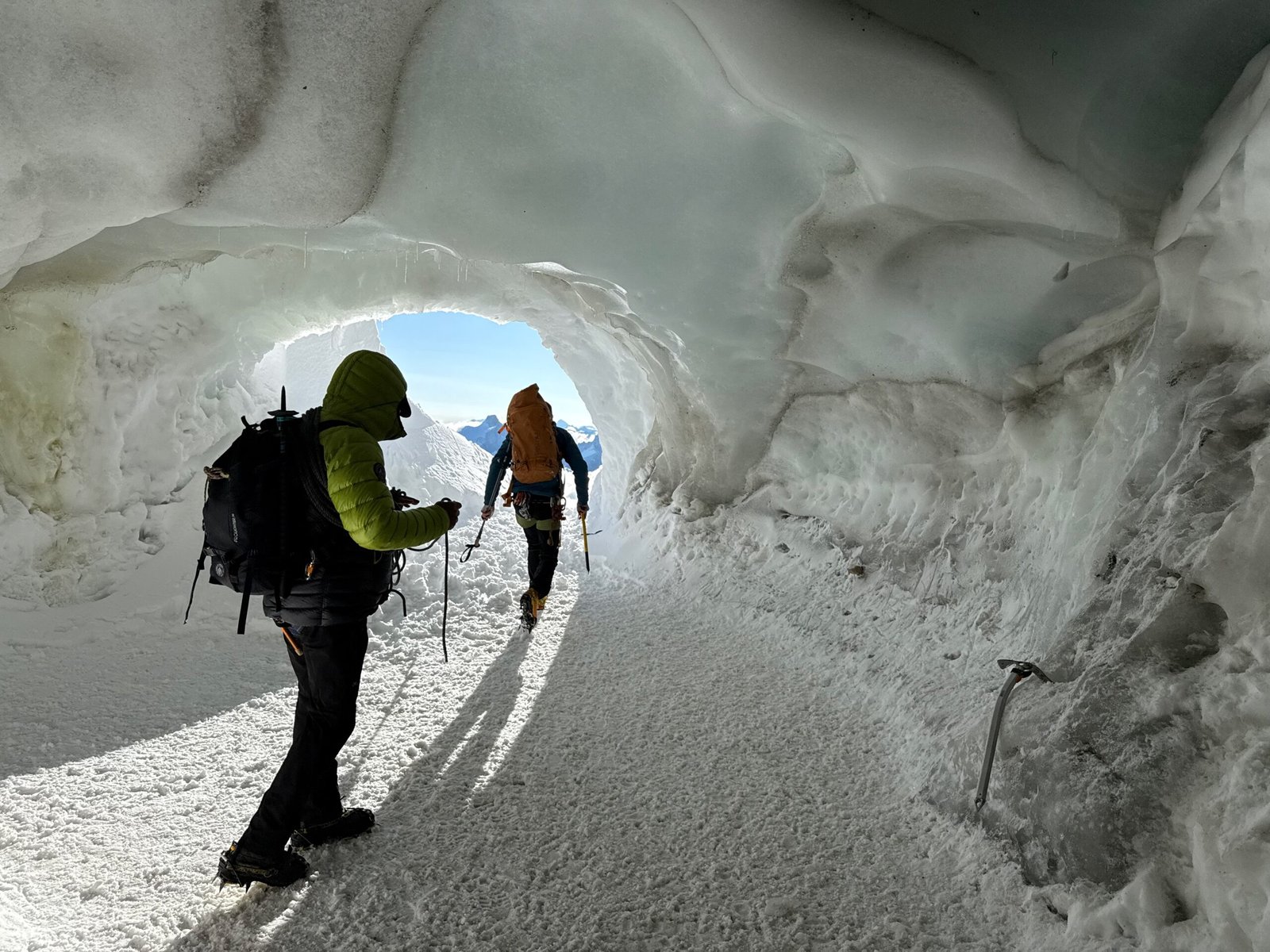
Even in mid-summer, the wind carried a bite. Snow clung to shaded ledges, a reminder that up here, winter never really leaves. At this altitude, the sun feels more intense, as there’s less atmosphere to filter its rays, so sunglasses are as essential as a warm jacket.
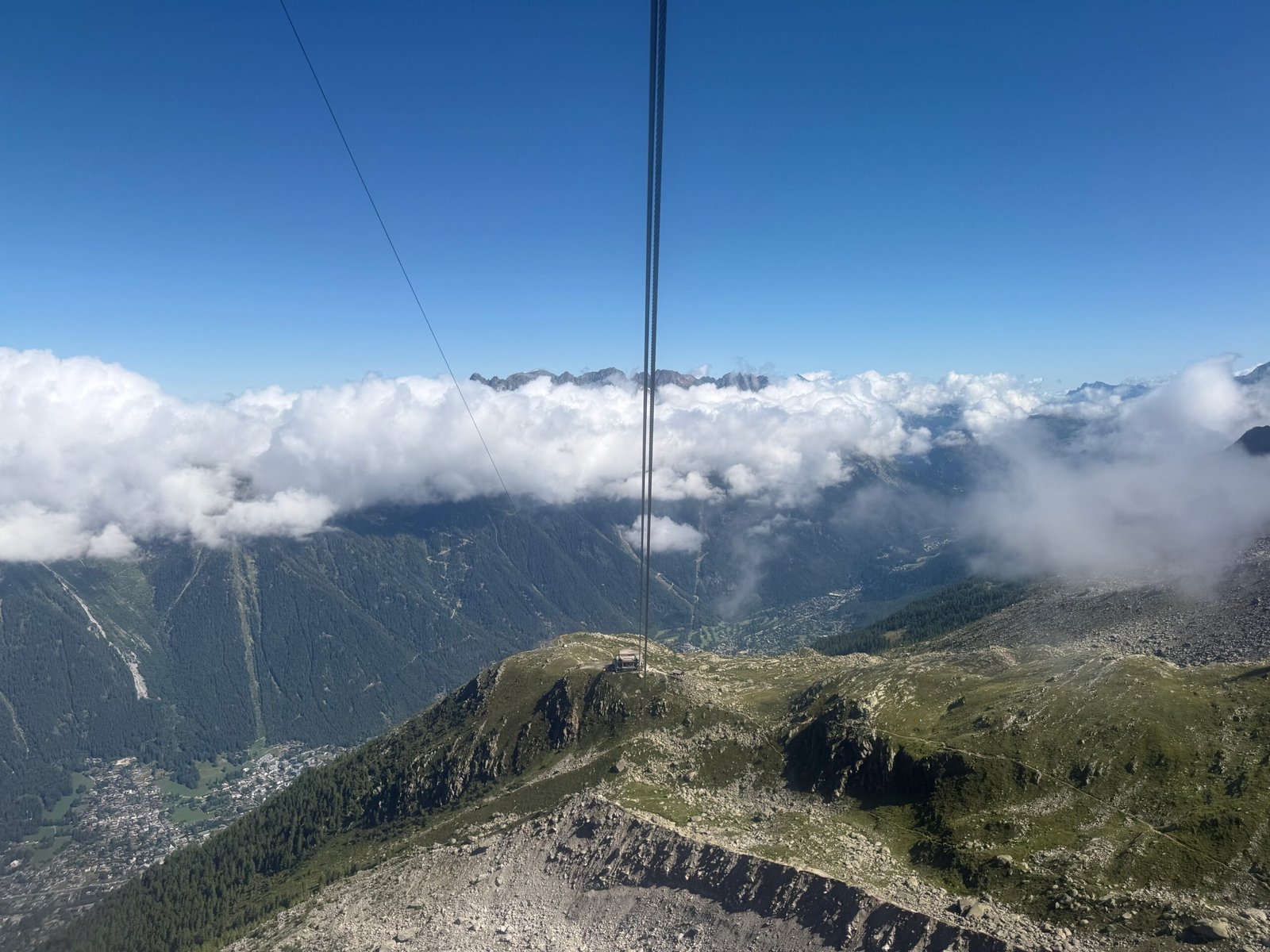
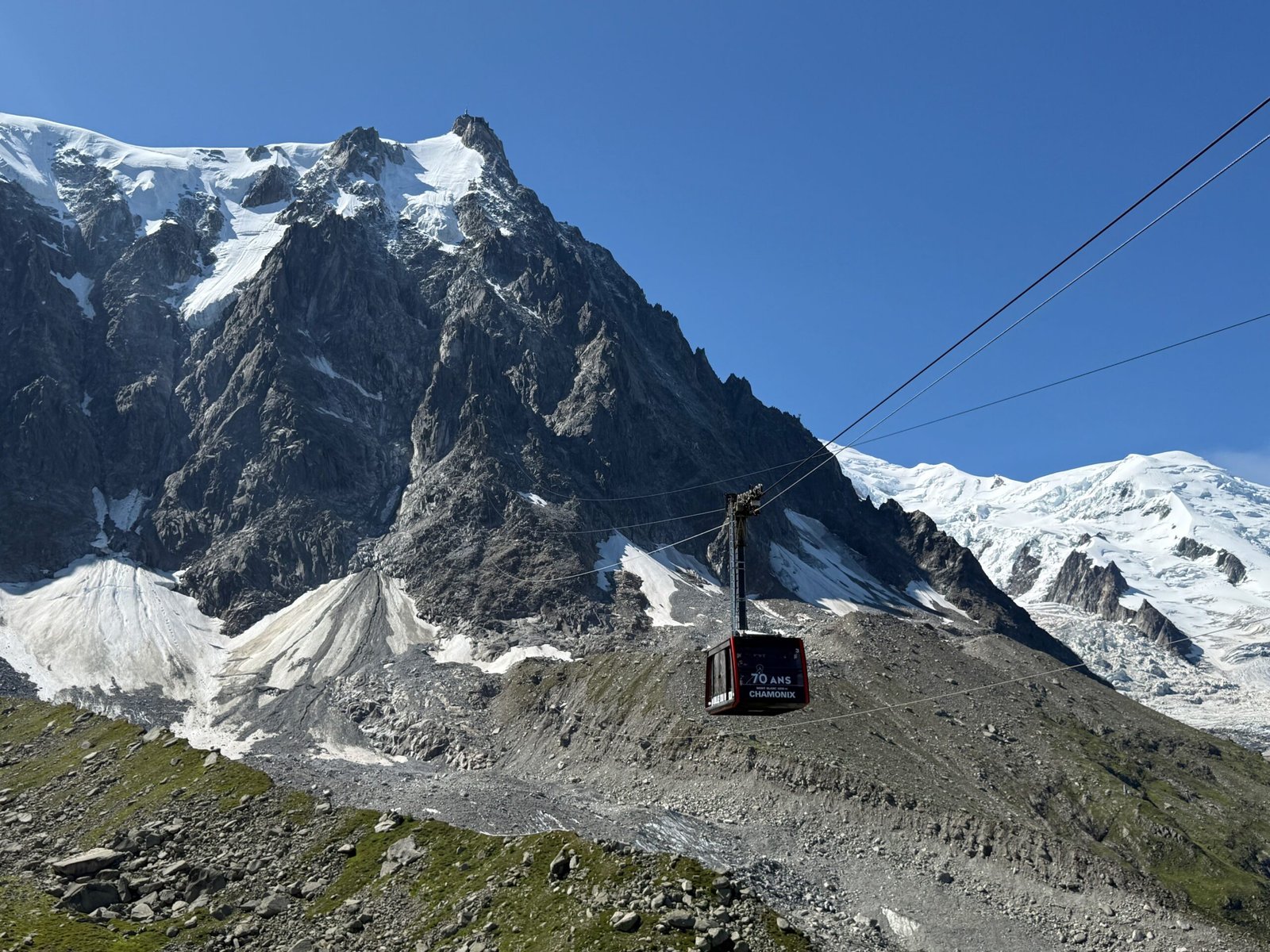
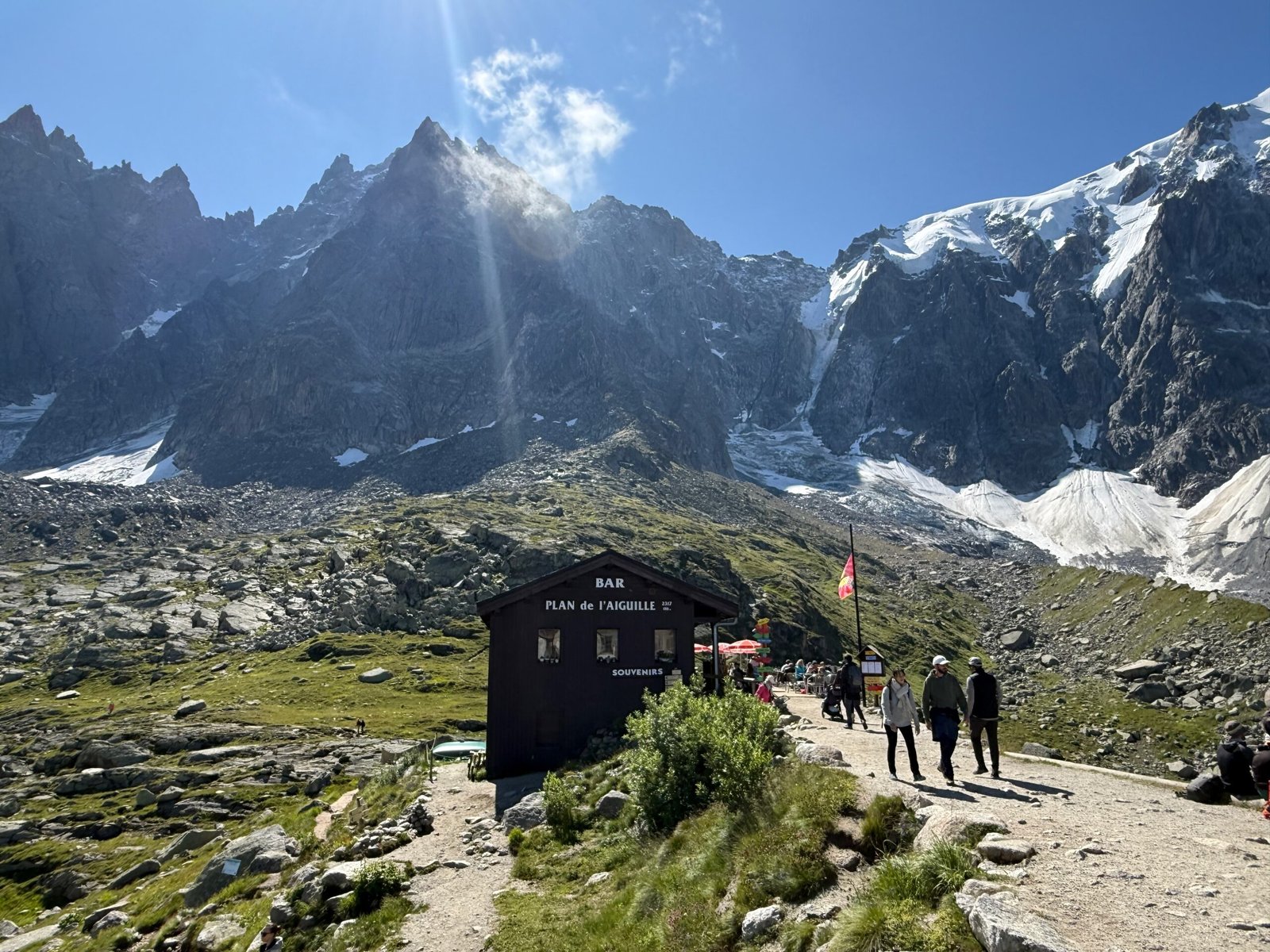
After nearly two hours at the summit, it was time to descend. On the way down, I hopped off at the mid-station at Plan de l’Aiguille to linger a while. The view back up to the Aiguille was spectacular, its granite spire jutting into the blue sky. Around me, alpine meadows burst with wildflowers, and the air was filled with the ring of chirping of birds and the excited voices of visitors revelling at the spectacular alpine view. It was the perfect place to pause, breathe deeply, and soak in the high-mountain environment before returning to the bustle of Chamonix.
Aiguille du Midi’s Towering Broadcast Antenna
One of the most obvious features of the Aiguille du Midi, visible even from the valley floor, is the tall broadcast antenna rising from its peak. Operated by Télédiffusion de France (TDF), this is France’s highest-altitude television and FM radio transmission site, perched at an elevation of 3,842 metres. As a licensed ham radio operator, this towering antenna piqued my curiosity immensely – not just for its engineering, but for the incredible reach it must have from such a lofty vantage point.
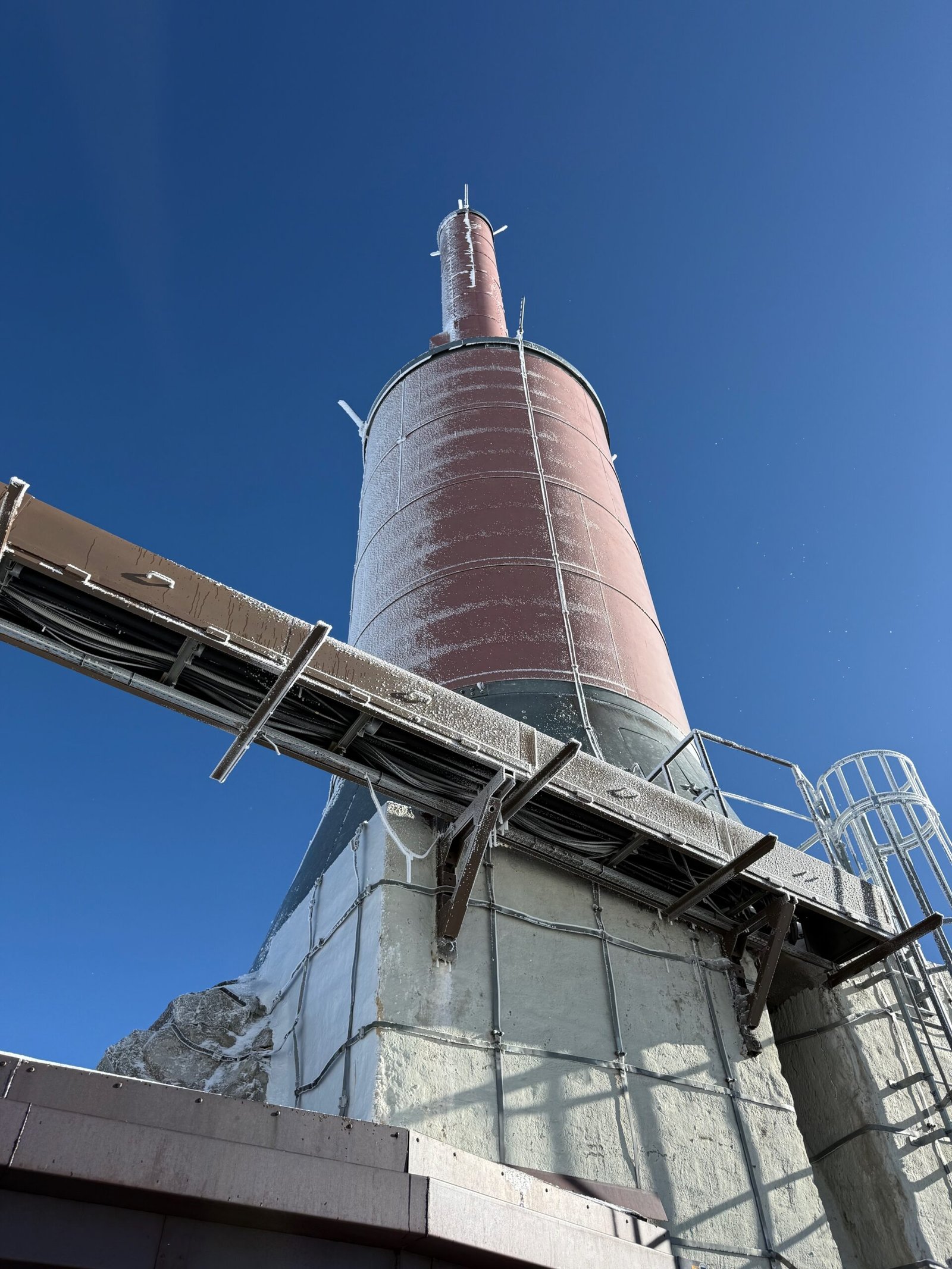
Historically, it carried analog television channels such as TF1, France 2, and France 3. Today, it transmits a range of digital multiplexes for national channels including France 2, BFM, M6, and Arte. On the FM side, it broadcasts public radio stations like France Culture, France Musique, France Inter, and the local Ici Pays de Savoie.
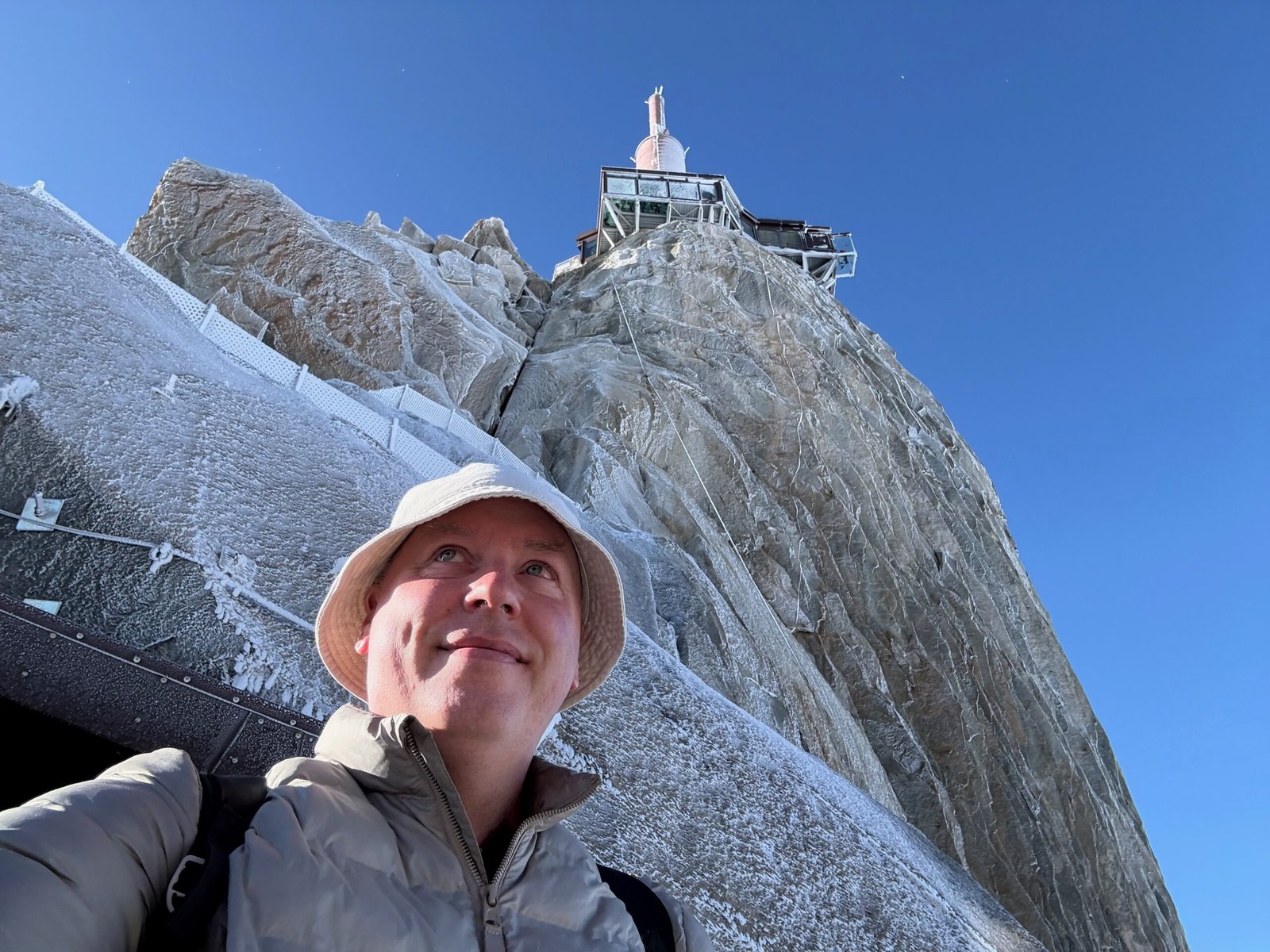
While the transmitters run at modest power levels, around 2.6 kW for analog TV, up to 630 W for digital, and 50 W for FM, their position at such an extraordinary altitude gives them an exceptional broadcast range. In fact, this site is believed to offer the longest technical range of any FM transmitter in Europe, with signals stretching across the Alps and, in the right conditions, reaching as far as southern Germany for enthusiasts equipped with directional antennas.
9 Practical Tips for Visiting Aiguille du Midi
Reaching the Aiguille du Midi is an unforgettable experience, but a little preparation can make your visit smoother, safer, and far more rewarding.
- Reserve Early: Tickets sell out quickly in summer. Morning slots often have the clearest views.
- Dress for Winter: Layers, gloves, a hat and sunglasses are non-negotiable.
- Know Your Altitude: Move slowly, stay hydrated, and be aware of altitude sickness symptoms.
- Maximize Your Multipass: The Mont Blanc Multipass also includes the Mer de Glace and Montenvers train.
- Plan Time for the Mid-Station: The Plan de l’Aiguille stop (2,317 m) offers great hiking and views back toward the peak.
10 Pro Tips for the Science Traveler
The Aiguille du Midi isn’t just a feast for the eyes – it’s a living classroom where geology, climate, and human physiology reveal their secrets to the curious observer.
- Inspect the Engineering: Look closely at how the station is anchored into the granite and how its tunnels were carved into the mountain. From the mid-station to the summit, the cable span is one of the longest unsupported in the world – remarkably slender yet able to carry fully loaded cabins and its own immense weight.
- Watch the Glacier: From the viewing platforms, you can see the Vallée Blanche glacier spilling down from Mont Blanc toward the Mer de Glace. It may appear frozen in place, but like all glaciers, it’s in constant motion and flows at an average of 50 to 80 meters per year, slowly sculpting the valley beneath it.
- Look for Climate Clues: Snowlines and glacier tongues have shifted dramatically in recent decades. A prime example is the receding Mer de Glace glacier.
- Feel your Physiology Change: Your body is adjusting to oxygen scarcity in real time.
- Visit the Learning Areas: Explore exhibits like the Espace Vertical and Altitude Experience, which explain Alpine geology, glacial science, and the engineering feats behind the station.
- Spot the Peaks: From the viewing platforms, identify landmarks like Mont Blanc, the Dent du Géant, the Grandes Jorasses, and peaks across Italy and Switzerland – each with its own geological story.
11 Conclusion: My Day on the Needle
I left the Aiguille du Midi with wind-chilled cheeks and a mind brimming with wonder. It wasn’t just the view, it was the feeling of standing at a crossroads of deep time, human ambition and engineering marvel. The granite beneath my feet had been forged in the bowels of the Earth; the station above it was the work of human ingenuity; the glaciers below were living rivers of ice, sculpting the land.
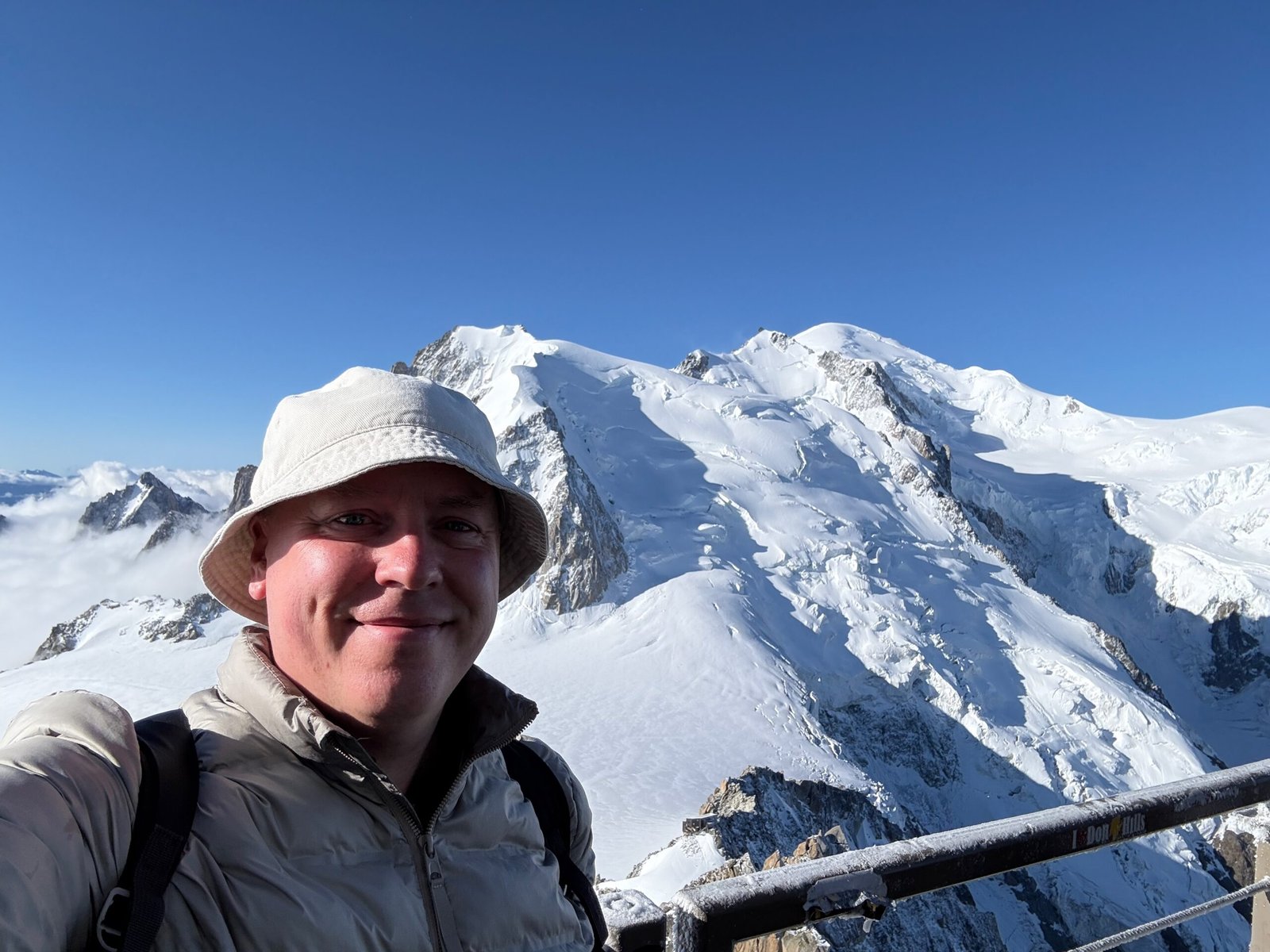
For a science traveler, it was the perfect convergence of geology, climate, engineering, and raw adventure. And as the cable car carried me back to the warmth of Chamonix, I already knew: I would be back. Because the Alps, like the forces that built them, are never still.
12 More Science Travel Stories
If you found yourself captivated by the geology, engineering, and alpine wonder of Aiguille du Midi, here are two more science-infused adventures you’ll love: