
For as long as I can remember, I’ve wanted to see the Moncton tidal bore – so I stood on the banks of the Petitcodiac River to witness a wall of Fundy seawater surging upstream. I watched surfers ride a metre-high chocolate wave, felt the boardwalk tremble, and uncovered the science and restoration efforts behind this daily wonder.
1 Homecoming to See the Moncton Tidal Bore
It’s often said that we travel far and wide while overlooking the wonders in our own backyard. I was certainly guilty. Growing up in New Brunswick, I treated the natural spectacles that lured tourists to this scenic province – the Fundy’s giant tides, Hopewell’s flowerpot rocks, even Moncton’s famous tidal bore, as background scenery – places I thought of as destinations for tourists, not locals like me. It wasn’t until I relocated to Toronto and booked a summer flight home that I finally penciled the bore onto my “must-see” list.
My itinerary was simple: land at Moncton’s airport late the night before, stay downtown along the riverfront, and check out just before the incoming tide would meet me at lunch time. Nature, for once, agreed – the bore was forecast for 12:15 pm on a blue-sky Saturday in August.
I stayed at Château Moncton, which is right along the riverfront, and was impressed by its comfort, friendly service, and how conveniently positioned it was for catching the tidal bore at different times of day. If you want to make the most of your visit (especially for photography or early morning viewing), this hotel makes a great base. You can also explore other Moncton hotel options to find a stay that suits your style and budget.
2 Quick Facts About the Moncton Tidal Bore
- Location: Moncton, New Brunswick, Canada.
- Wave Height: ~0.5 m – 1 m (1.6 – 3 ft) crest and up to 1.2 m (4 ft) on spring tides).
- Bore Speed: 5 – 13 km/h (3.1 – 8.1 mph).
- Tidal Range: Up to 14 m (46 ft) for the Bay of Fundy.
- Frequency: Twice daily (~12 h 25 m apart).
- Viewing Times: Check the official Government of Canada Moncton tidal bore tidal schedule.
- Best Viewing Places: Along Riverfront Park or Bore Park.
3 Moncton’s Chocolate River
First light outside my hotel window revealed the Petitcodiac in all its muddy glory. Locals affectionately call it the “Chocolate River,” and from my hotel room window, it looked exactly like a ribbon of thick cocoa winding through tan salt marshes. The colour isn’t pollution; it’s a byproduct of Fundy’s monster tides.
As more than 100 billion tonnes of seawater slam into the shallow estuary twice a day, the incoming surge scours the riverbed, suspending fine silt and turning the surface a latte shade of brown. That same tide also engineers one of Earth’s more curious hydraulic tricks: a tidal bore – a single wall of water that bulldozes upstream against the river’s natural flow.
4 What Exactly Is a Tidal Bore?
In the simplest terms, a bore is a moving, turbulent hydraulic jump – picture a traveling waterfall turned on its side. Three ingredients must align:
- A tidal range of at least six metres (20 feet).
- A funnel-shaped estuary that narrows inland.
- A broad, shallow riverbed that forces the sea’s momentum upward instead of forward.
The Bay of Fundy supplies the first ingredient in spades; its tides routinely rise 14 metres (46 feet), the highest vertical swing on the planet. The Petitcodiac’s sandbars, once glacial outwash, add the second and third. When the advancing flood meets the outgoing river current, trapped energy resolves itself in a fast-moving wave that can travel 5–13 km/h and lift the river surface by half a metre to a full metre in mere seconds.
5 Moncton Tidal Bore Times
One of the first questions visitors ask is: “When is the Moncton tidal bore?” The tidal bore occurs twice a day as the powerful Bay of Fundy tides push upriver into the Petitcodiac River. Exact arrival times vary from day to day, depending on the lunar cycle and tide levels.
For the most accurate schedule, check the official Government of Canada Moncton tidal bore times. This schedule lists the Time ADT and the Relative Height for the Moncton tidal bore. The Relative Height indicates the bore’s size, where 1 is the smallest and 4 is the largest.
Tidal bore arrivals are usually given for the viewing area near downtown Moncton, making it easy to plan your visit.
Tip: Arrive at least 15–20 minutes early – the wave can appear sooner than expected and its size varies with tide and weather conditions.
6 You Might Also Like:
- Hopewell Rocks Tides & Geology: Science of the Ocean Floor – Discover how Fundy’s tides sculpt towering sea stacks and explore the geology revealed on the ocean floor at low tide.
- Reversing Falls Saint John: Tides, Rapids & Viewing Guide – Watch the Saint John River clash with the Bay of Fundy tides, creating reversing rapids, whirlpools, and dramatic viewing opportunities.
- Why the Bay of Fundy Tides Are the World’s Highest – Learn the science behind the Bay of Fundy’s record-breaking tides and why they rise higher here than anywhere else on Earth.
7 Where to Watch the Moncton Tidal Bore
The best place to see the tidal bore in Moncton is along the Petitcodiac River in the heart of downtown. Visitors gather near Bore Park and the nearby viewing area on Main Street, where the Riverfront Park boardwalk and interpretive signs offer a clear view of the wave as it rolls upriver.
When I visited, I chose to watch the tidal bore from the boardwalk in front of the Château Moncton. It’s one of the most popular vantage points, offering a comfortable riverside view with easy access to the downtown area. From here, you can watch the wave approach from the bend in the river and enjoy the atmosphere alongside other visitors.
Another popular viewing point is the Gunningsville Bridge, which crosses the river between Moncton and Riverview. From here, you can watch the bore surge past with a wide perspective of the river valley.
If you prefer a quieter spot, head further upriver toward Riverview or Dorchester. The wave is smaller in these areas but still dramatic, and you’ll often have the viewing area to yourself.
8 A Crowd Gathers Along the Boardwalk
By noon I joined a small summer carnival of humanity along the boardwalk by the Château Moncton: families fanning themselves with souvenir brochures, lens-toting photographers, and half a dozen wetsuit-clad surfers bobbing in the opaque water below, waiting to hitch a ride upriver.
Only a handful of rivers worldwide host a tidal bore, and Moncton’s is the largest easily accessible one in North America. I first learned about tidal bores years earlier, captivated by a TV documentary showing surfers riding the Pororoca – a roaring tidal wave that travels deep into the Amazon rainforest. Now, standing under the noon heat shimmering off the planks, it struck me how extraordinary it was to witness a similar phenomenon right here at home. The collective hush along the boardwalk felt like a theatre audience moments before curtain.
9 The White Line – First Sight of the Bore
At 12:13 pm, a thin, chalk-white seam appeared on the downriver horizon. For an instant I mistook it for glare – then the stripe expanded. The bore’s leading edge stretched bank-to-bank, a crescent of agitated foam bulldozing the placid chocolate river ahead of it. I’d expected a languid creep, something you could stroll beside. Instead, the wave raced toward us in under two minutes, outrunning gulls that tried to hover above its foamy crest.
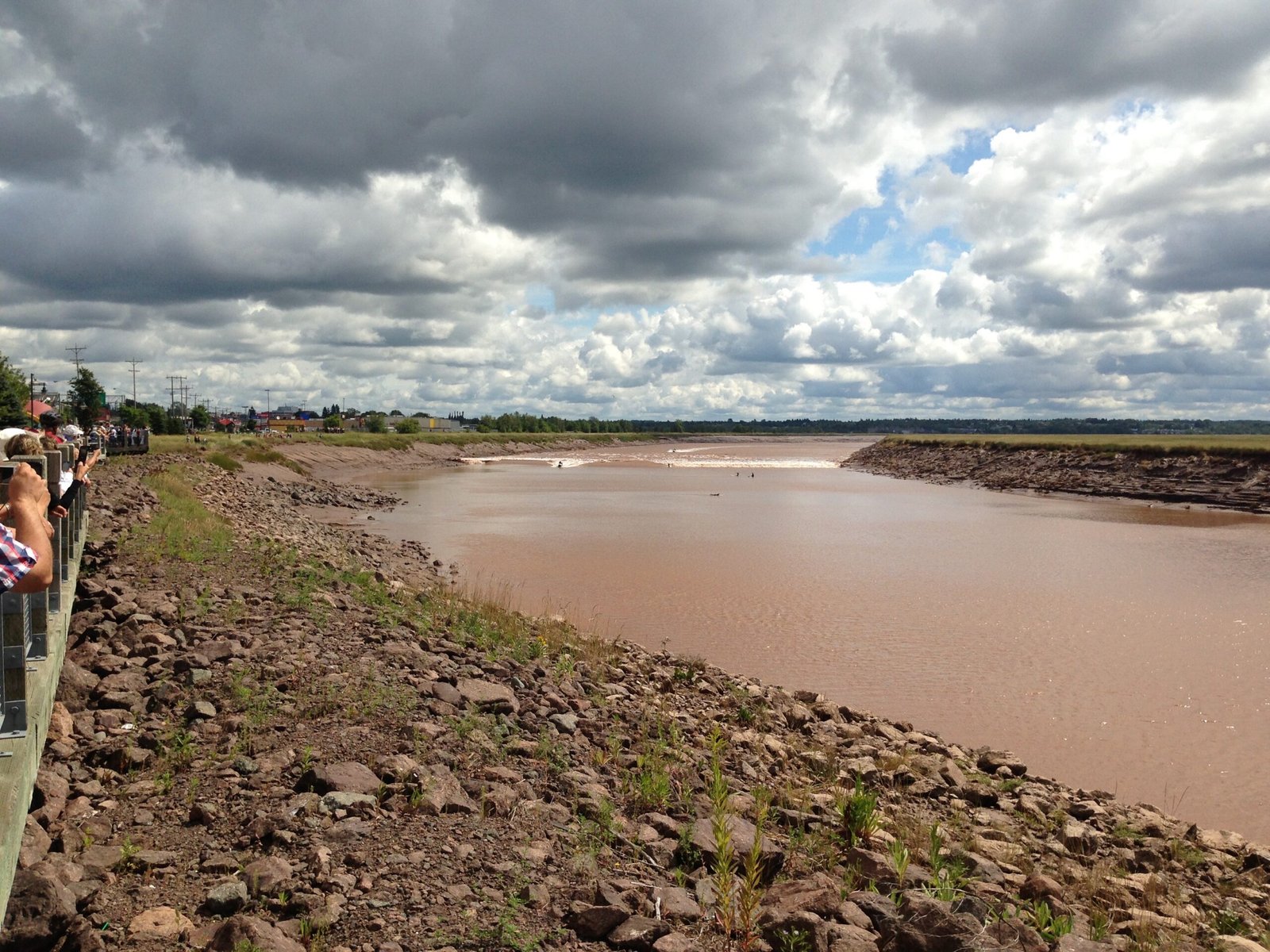
Adrenaline tickled my knees; the power felt disproportionate to the wave’s one-metre height, as though the whole ocean were breathing through a single exhale.
10 Surfing the Chocolate River Wave
By 12:15 pm the wave was right in front of us. The surfers sprang from prone to crouch, noses pointing upriver. It scooped them up like toys, embedding their boards in its muddy shoulder. Cheers erupted from the boardwalk as they glided past – mini‑Mavericks riders in wetsuits splattered with silt instead of salt.

One paddler managed a shaky cutback before the river battered him off his deck; another rode the wave nearly two kilometres (1.2 miles), the bore’s momentum outlasting my sightline. According to local outfitters, an experienced paddler can surf a Fundy bore for upwards of 25 minutes on spring tides.
11 The Science Beneath the Spectacle
Standing above the churn, I tried to imagine the invisible physics unfolding beneath that opaque skin. Each bore begins as a slight bulge – a tidal wave rushing into narrowing territory. Friction with the riverbed slows the lower layer, steepening the front until it finally overturns into a rolling breaker.
The process is called hydraulic-jump transformation, the same principle engineers harness in spillways to dissipate dam outflows. Yet unlike a stationary dam jump, a bore marches forward, an orphan wave carrying its own steep beach. In cross-section, flow becomes supercritical (faster than the speed of shallow-water gravity waves) ahead of the crest and subcritical behind it – a natural shockwave every paddler can literally ride.
The Bay of Fundy doesn’t express its power in Moncton alone. Just a hundred kilometres southwest, those same tides reverse the flow of the Saint John River in a frothing display known as the Reversing Falls. Farther down the coast, Fundy’s currents collide in Passamaquoddy Bay to create the swirling Old Sow Whirlpool – North America’s largest tidal vortex.
12 A River Reborn After Half a Century
If I’d made this pilgrimage ten years earlier, the spectacle would have been a disappointment. In 1968 a concrete causeway straddled the Petitcodiac, choking the estuary and reducing the once-majestic bore to a ripple measured in inches.
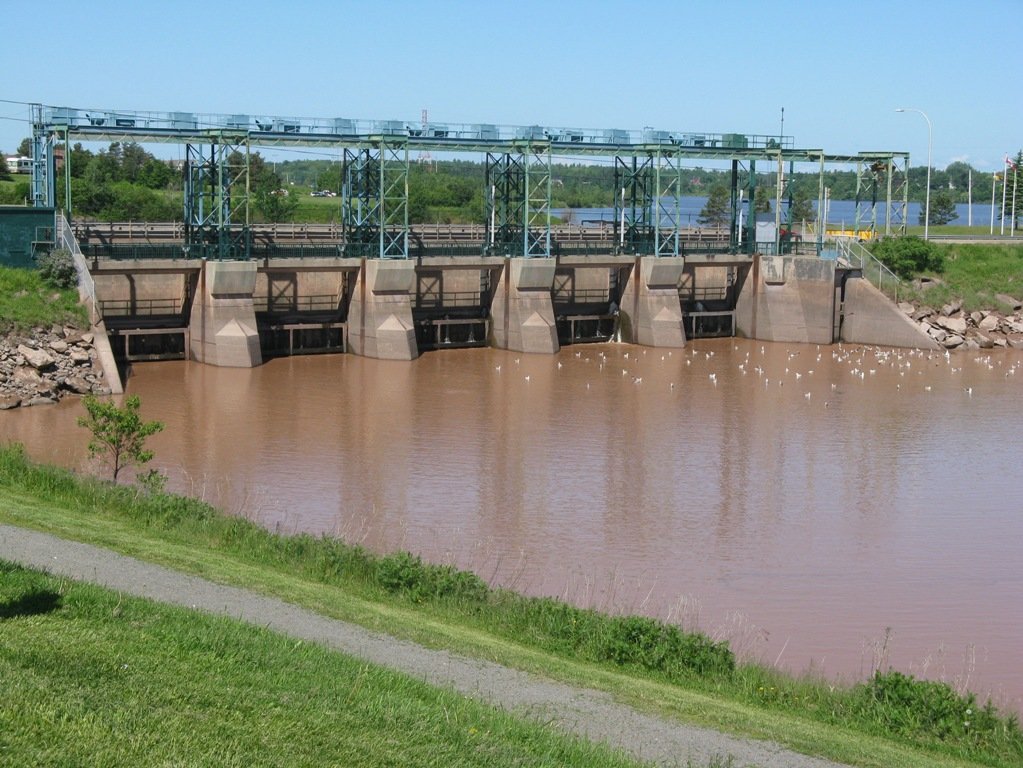
Photo Credit: Petitcodiac Riverkeepers
Environmental groups fought for decades to reopen the gates, and in 2010 they finally swung ajar. Eleven years later the causeway was demolished and replaced with a bridge, allowing the river to reconnect with Fundy’s pulse. Engineers monitoring the channel noted the bore growing “closer to its pre-1968 levels” – already exceeding early predictions by the first full year of free flow.
13 Ecology Riding the Wave
Restoring the bore did more than entertain tourists; it rebooted an estuarine ecosystem. As the riverbed scoured clean, tens of thousands of gaspereau and other anadromous fish returned to spawning grounds upstream. Mudflats once starved of oxygen now host invertebrates that fuel migrating shorebirds. Even sediment-loving salt-marsh grasses are recolonizing the banks at a rate scientists hadn’t predicted until the late 2020s.
In a poetic twist, the bore is both a barometer and a catalyst of river health – the bigger the wave, the stronger the estuary, and vice versa.
14 Practical Tips for Viewing the Moncton Tidal Bore
Here are some practical tips I picked up during my visit to the Moncton tidal bore to help you make the most of your experience, from timing your arrival to staying safe along the riverside.
- Arrive early: Claim your spot along the boardwalk 20–30 minutes ahead; the crowd thickens fast on weekends and during spring tides.
- Verify the schedule twice: The night before and morning of; atmospheric pressure and strong winds can nudge the bore a few minutes early or late.
- Footwear counts: Boardwalks are sneaker-friendly, but if you’ll explore the mudflats after the wave, pack knee-high rubber boots, as the silt behaves like wet concrete.
- Dress in layers: A Bay of Fundy sea breeze can drop the temperature 5–10 °C (41-50°F) when the tide rolls in.
- Parking & transit: Free lots sit behind Bore View Park; public buses 60 & 61 stop within a 5-minute walk.
- Accessibility: Two wheelchair-friendly viewing decks provide unobstructed sightlines and tactile information panels.
- Facilities: Public washrooms and water fountains are located 200 m (656 ft) east of the main deck; expect lineups right after the bore.
- Safety first: Stay above the high-water line and heed staff flags – bore fronts can undercut banks and create whirlpools.
15 Pro Tips for the Science Traveler
If you’re keen to dive into the science behind tidal bores and get even more out of your observation at the Moncton tidal bore, these expert tips will enrich your experience.
- Capturing Slow Motion: Shoot slow-motion video (120 fps or higher); step-through playback reveals the rolling hydraulic jump you can’t catch at normal speed.
- Recording a Time-Lapse: Clamp a GoPro to the railing for four hours to record the full 14-metre (46 feet) rise and fall – perfect for classroom demos.
- Talking to Researchers: Speak with watershed researchers from the Petitcodiac Watershed Alliance; they often sample fish after the bore and may be happy to answer questions.
- Pairing Natural Phenomena: Hit Hopewell Rocks at low tide the same day for an ebb-and-flow story arc; measure cliff height versus tidal swing.
- Logging Data Sets: Log the bore’s crest height and speed, then contrast your results with data from other bores, like the Severn (UK) or Qiantang (China) bores.
16 FAQs About the Moncton Tidal Bore
When is the Moncton tidal bore?
The Moncton tidal bore occurs twice a day as the Bay of Fundy’s incoming tide forces seawater up the Petitcodiac River. Arrival times vary daily with the tide and moon phases – check the official Government of Canada Moncton tidal bore schedule for the most accurate times.
What are the Moncton tidal bore times today and tomorrow?
For up-to-date bore times, visit the official Government of Canada Moncton tidal bore schedule. It lists today’s and tomorrow’s predicted arrival times and the Relative Height (1–4) indicating the wave’s size.
Where is the best place to watch the tidal bore?
The most popular spots are along the Riverfront Park boardwalk or Bore Park in downtown Moncton. These elevated viewing areas have interpretive signs and provide a clear, unobstructed view of the wave.
How big is the Moncton tidal bore?
The bore’s size varies from a gentle ripple to a wave over a metre high. The official tide chart lists a Relative Height from 1 (smallest) to 4 (largest).
What causes the Moncton tidal bore?
The tidal bore forms when the Bay of Fundy’s massive tides surge into the narrow Petitcodiac River channel, forcing seawater upstream against the river’s natural flow and creating a rolling wave.
When is the best time of year to see it?
You can see the tidal bore year-round, but it’s most dramatic during spring and fall, especially near the new and full moons when the Bay of Fundy tides reach their highest levels.
Why is the Petitcodiac River called the “Chocolate River”?
Locals nicknamed it the “Chocolate River” because of its rich brown colour – the result of silt churned up by the powerful Bay of Fundy tides.
Why is the Petitcodiac River brown?
The river’s chocolate-brown colour comes from fine silt and clay suspended in the water. The fast-moving tidal bore constantly stirs up these sediments from the riverbed, giving it a muddy look.
17 Beyond the Wave: A City Shaped by Tides
Moncton has woven the bore into its urban fabric. Restaurants time patio seatings to the midday crest; breweries name stouts after the “Chocolate Wave.” Interpretive plaques along the Riverfront Trail explain everything from Mi’kmaq legends to the physics of hydraulic jumps, while a new visitor centre maps the bore’s route against decades of aerial photography.
The city that once turned its back on a muddy trickle now markets it as living theatre, and the crowds prove the strategy is working. On peak summer days, upwards of 1,500 spectators gather for a single tide.
18 Reflections on a Moving Landmark
Watching the Petitcodiac taught me that a river is never a fixed landmark; it is a living, oscillating suture between land and sea. In twenty minutes, the tidal bore rewrote the river’s flow direction, sediment load, even its colour gradient. By dinner, the tide would retreat, and the river would slouch seaward again, biding its time for round two.
That cyclical resilience feels like an emblem for the Maritimes themselves – buffeted by forces larger than us, yet always ready to surge back.
Some links in this story are affiliate links. If you choose to buy through them, Curious Don may earn a small commission – at no extra cost to you. It helps support more science travel stories like this.